


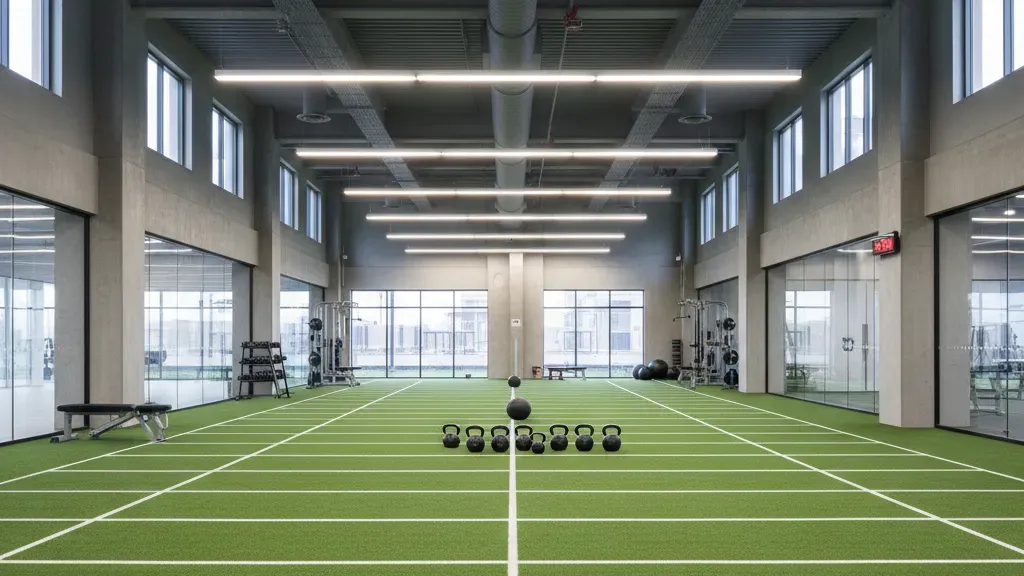
Synthetic Turf for Indoor Spaces: Gyms, Event Venues and Showrooms
Indoor synthetic turf is showing up in more commercial spaces than most people expect. Gyms are laying it down for functional training zones. Event venues are using it to create standout floor surfaces that hold up under hundreds of guests. Showrooms are installing it to give customers a hands-on look at what the product actually feels like underfoot.
Contact Go Green Synthetic Turf to find the right indoor turf product for your next commercial project.
But indoor applications bring a different set of requirements than a typical backyard install. Fire codes, ventilation, ADA accessibility, subfloor preparation, and product selection all change when you move turf inside. This guide breaks down what facility managers, architects, and installers need to know before specifying indoor artificial grass for commercial spaces.
Why Commercial Spaces Are Moving to Indoor Artificial Grass
The shift toward indoor turf is driven by practical problems. Gym owners need flooring that can take sled pushes, dropped weights, and heavy foot traffic without cracking, peeling, or compressing flat. Event planners want something that creates a visual impact and can be cleaned between bookings without specialized equipment. Retail showrooms need a surface that looks fresh after thousands of visitors walk across it.
Traditional flooring options each fall short in some way. Rubber mats work for gyms but look industrial. Carpet wears fast under heavy traffic and traps moisture. Hardwood and tile crack under impact. Synthetic turf fills a gap because it absorbs impact, drains well, and keeps a consistent appearance over years of use.
There is also a branding component. A gym with a turf training zone signals seriousness. An event venue with a green turf floor creates a memorable setting that photographs well. A showroom with HeatMaxx Soft technology installed on the floor lets customers touch, stand on, and compare products in person.
According to Grand View Research, the global artificial turf market is projected to reach over $5 billion by 2030. Commercial and indoor applications are one of the fastest-growing segments, driven by demand from fitness facilities, hospitality venues, and retail environments.
What Makes Indoor Turf Different from Outdoor Turf?
Indoor artificial grass is not the same product you would lay in a backyard. The environment is different, and the requirements shift in a few important ways.
Fire safety is the biggest difference. Outdoor turf does not face the same fire code scrutiny because open air reduces risk. Indoor spaces, especially commercial ones, must meet building codes for flame spread, smoke density, and fire resistance. Any turf installed in an enclosed commercial space should carry a Class A fire rating (ASTM E648), which is the highest classification for flooring materials.
Most polyethylene turf (the standard material used in residential lawns) melts at around 165 degrees Fahrenheit. That is a problem in indoor spaces where fire inspectors will check compliance. Nylon turf withstands temperatures up to 428 degrees Fahrenheit and earns the Class A rating that commercial codes require. This is not a minor technical detail. It is the difference between passing inspection and pulling up your floor.
Other key differences for indoor turf include:
- Ventilation and off-gassing: Indoor spaces need turf with low VOC emissions. Nylon fibers and urethane backings typically perform better than recycled rubber infill systems in enclosed environments.
- Subfloor compatibility: Outdoor turf sits on compacted base material and drainage aggregate. Indoor turf installs directly on concrete, plywood, or raised subfloor systems. The backing and adhesive system must be matched to the substrate.
- UV exposure: Outdoor turf needs UV stabilization because sunlight degrades polyethylene. Indoor turf sees minimal UV, which extends the product lifespan and opens up material options that would fade outdoors.
- Drainage requirements: Outdoor turf drains through the backing into the ground. Indoor turf may need perimeter drainage or sealed backing, depending on the application. Gym turf that gets mopped needs different drainage characteristics than a showroom floor that stays dry.
Fire Safety Requirements for Indoor Synthetic Turf
Fire safety is the single most important factor when selecting turf for any enclosed commercial space. Building inspectors, insurance underwriters, and local fire marshals will all want documentation.
Here is what you need to know:
ASTM E648 (Critical Radiant Flux): This test measures how a flooring material responds to radiant heat. Class I (Class A) means the material resists ignition at the highest level. This is required in most commercial corridors, lobbies, and assembly spaces. Go Green’s HEATMAXX SOFT 47 and HEATMAXX SOFT 65 both carry Class A fire ratings, making them compliant for commercial indoor installations.
ASTM E662 (Smoke Density): Measures the optical density of smoke produced by a burning material. Low smoke density is critical in enclosed spaces where visibility affects evacuation safety.
Local Building Codes: International Building Code (IBC) Section 804 governs interior floor finishes. Most commercial spaces classified as Assembly (A), Business (B), or Mercantile (M) occupancies require Class I interior floor finishes. Some jurisdictions have additional requirements, so always check with your local authority having jurisdiction (AHJ).
The practical takeaway: if you are specifying turf for an indoor commercial space, ask the manufacturer for test reports showing ASTM E648 Class I results. If they cannot provide them, that product should not go inside a commercial building.
For more on synthetic turf safety standards, see our full safety guide.
ADA Compliance and Accessibility for Indoor Turf
Commercial indoor spaces must meet Americans with Disabilities Act (ADA) requirements for accessible flooring. This applies to gyms, event venues, showrooms, lobbies, and any space open to the public.
ADA-compliant turf flooring must meet these criteria:
- Firm, stable, and slip-resistant: The surface must allow wheelchair passage, walker use, and safe walking for people with mobility challenges. Loose or overly cushioned surfaces that impede wheelchair movement do not comply.
- Pile height limits: Carpet and turf pile height should not exceed 1/2 inch in ADA access routes unless the turf is specifically certified for wheelchair compliance. Products certified ADA compliant, like the HEATMAXX SOFT 65 (1-5/8 inch pile height, ADA wheelchair compliant), have been tested to confirm wheelchair maneuverability despite taller pile.
- Transition strips: Where turf meets hard flooring (tile, concrete, wood), the transition must be gradual and not exceed 1/4 inch in height change without a beveled edge.
- No infill required: Some indoor turf products are designed to stand upright without infill, which simplifies ADA compliance because there is no loose material to impede wheelchair movement. The HEATMAXX SOFT 47 is one example, with a fiber design that maintains an upright position without infill.
For event venues hosting public events, ADA compliance is not optional. Temporary turf installations for trade shows, weddings, or corporate events still need to allow wheelchair access across the surface.
Talk to a Go Green installation specialist about ADA-compliant turf options for your indoor project.
Indoor Turf Applications by Space Type
Different indoor spaces have different performance requirements. Here is how turf selection breaks down by application.
Gyms and Fitness Facilities
Functional training zones, sled tracks, stretching areas, and open workout floors are the most common gym turf applications. The turf needs to handle repeated sled pushes (which generate friction heat), dropped kettlebells, and constant foot traffic from athletic shoes.
For gyms, nylon turf outperforms polyethylene because it resists abrasion from sled runners and high-friction activities. A nylon artificial turf with a face weight of 47 to 65 oz/sy provides the durability and pile recovery that gym environments demand.
Consider these specifications for gym turf:
| Specification | Recommended Range | Why It Matters |
|---|---|---|
| Fiber Material | Nylon 6,6 | Highest abrasion resistance for sled pushes and heavy foot traffic |
| Face Weight | 47-65 oz/sy | Higher weight = denser pile that recovers faster after compression |
| Pile Height | 1-3/8 to 1-5/8 inches | Short enough for stability, tall enough for cushioning |
| Backing | Urethane | Bonds to concrete subfloors without separating under lateral force |
| Fire Rating | Class A (ASTM E648) | Required for commercial gym occupancy |
Check out our guide to artificial turf for sports fields for more on athletic turf selection.
Event Venues and Hospitality Spaces
Event venues use indoor turf in lobby areas, reception halls, outdoor-themed event rooms, and temporary installations for weddings, trade shows, and corporate events. The priorities are different from gyms: appearance, ease of cleaning, and setup flexibility matter more than abrasion resistance.
For event venues, look for turf with a natural color blend (field green and olive, not solid bright green), soft hand feel, and a pile height that looks lush in photographs. The HEATMAXX SOFT 65 works well in these settings because its 1-5/8 inch pile creates a premium look and feel that stands up to high-traffic events.
Event venue considerations:
- Roll width and seaming: Large venues may need 15-foot roll widths to minimize visible seams. Discuss roll dimensions with your supplier early in the planning process.
- Cleaning between events: Choose a turf that can be vacuumed, spot-cleaned, and deodorized quickly. Products without loose infill are easier to maintain for high-turnover event spaces. Our cleaning and maintenance guide covers best practices.
- Temporary vs. permanent: Temporary installations (trade show booths, one-day events) can use double-sided tape or grip pads. Permanent installations should be fully adhered to the subfloor for safety and longevity.
Showrooms and Retail Spaces
Turf manufacturers and dealers use showroom installations to let customers experience the product firsthand. But showroom turf has broader applications. Home builders install it in model homes. Landscaping companies use it in their sales offices. Pet supply stores create demo areas.
In a showroom setting, the turf is both the product and the flooring. It needs to maintain its appearance with zero maintenance issues, because any flaw is what the customer sees. Products certified for indoor applications, like the HEATMAXX SOFT line, are designed to hold color, texture, and pile structure in climate-controlled environments without the UV degradation that affects outdoor products.
How to Choose the Right Indoor Turf Product
Selecting the right product starts with matching the turf specifications to the space requirements. Here is a decision framework:
Step 1: Identify the primary use. Is this a high-impact gym floor, a visual-first event space, or a showroom display? The answer determines whether you prioritize abrasion resistance, aesthetics, or versatility.
Step 2: Check fire code requirements. Confirm with your local building department or fire marshal what fire rating is required for your occupancy type. For most commercial indoor spaces, the answer is Class A (Class I).
Step 3: Confirm ADA compliance needs. If the space is open to the public, ADA compliance is required. Ask for wheelchair compliance test documentation.
Step 4: Evaluate the subfloor. Concrete, plywood, and raised flooring systems each require different adhesive and installation methods. A product with urethane backing generally bonds better to hard indoor subfloors than one designed for outdoor base material. See our synthetic turf installation guide for subfloor preparation details.
Step 5: Compare products side by side. Here is how Go Green’s indoor-certified products compare:
| Feature | HEATMAXX SOFT 47 | HEATMAXX SOFT 65 |
|---|---|---|
| Price | $5.35/SF | $6.30/SF |
| Face Weight | 47 oz/sy | 65 oz/sy |
| Pile Height | 1-3/8 inches | 1-5/8 inches |
| Fire Rating | Class A (ASTM E648) | Class A (ASTM E648) |
| ADA Compliant | Yes | Yes (wheelchair certified) |
| Indoor Certified | Yes | Yes |
| Infill Required | No | No |
| Warranty | 15-year prorated | 15-year prorated |
| Best For | Gyms, training facilities, sled tracks | Event venues, showrooms, premium commercial spaces |
For a broader look at product options, visit our synthetic turf products guide or browse the full product line.
Request a free quote for your indoor turf project. Our team will help you match the right product to your space.
Installation Considerations for Indoor Turf
Indoor turf installation differs from outdoor in almost every step. The subfloor is already in place, drainage works differently, and adhesive selection becomes critical.
Subfloor preparation: Concrete must be clean, dry, level, and free of sealers or coatings that prevent adhesive bonding. Cracks wider than 1/4 inch should be filled with a flexible filler. Plywood subfloors should be exterior grade, minimum 3/4 inch thickness, with seams staggered.
Moisture testing: Before installation on concrete, perform a calcium chloride moisture test (ASTM F1869) or relative humidity test (ASTM F2170). Moisture vapor emission rates above 3 lbs per 1,000 SF per 24 hours can cause adhesive failure and mold growth under the turf.
Adhesive selection: Indoor turf typically uses urethane-based adhesive applied directly to the subfloor. Avoid solvent-based adhesives in enclosed spaces due to VOC concerns. Water-based urethane adhesives provide strong bonding with lower emissions.
Seaming: Indoor installations require tight, invisible seams because the controlled lighting in commercial spaces highlights imperfections. Use seam tape designed for artificial turf and ensure fiber direction runs the same way across all panels.
For step-by-step installation details, read our complete installation guide.
Cost Considerations for Indoor Turf Projects
Indoor turf project costs depend on three main variables: the turf product, the subfloor condition, and the installation method.
Product cost: Indoor-rated nylon turf runs $5.35 to $6.30 per square foot for material. Premium products cost more than standard polyethylene, but nylon’s fire rating and durability often eliminate the need for secondary fire-resistant treatments or frequent replacement. Check our cost per square foot guide for a detailed breakdown.
Installation cost: Professional indoor installation typically adds $3 to $6 per square foot, depending on subfloor condition, project size, and local labor rates. This includes adhesive, seam tape, transition strips, and labor.
Total project cost estimate:
| Project Size | Material (HEATMAXX SOFT 47) | Installation | Total Estimate |
|---|---|---|---|
| 500 SF (small gym zone) | $2,675 | $1,500-3,000 | $4,175-5,675 |
| 2,000 SF (event venue) | $10,700 | $6,000-12,000 | $16,700-22,700 |
| 5,000 SF (large fitness facility) | $26,750 | $15,000-30,000 | $41,750-56,750 |
When comparing costs, factor in the lifespan of synthetic turf. A nylon product with a 15-year warranty and Class A fire rating may cost more upfront than polyethylene, but it avoids replacement cycles and fire code compliance issues that add cost over time. The commercial turf ROI analysis covers the full cost-of-ownership picture.
Frequently Asked Questions
Can you use artificial grass indoors?
Yes. Synthetic turf is used in indoor gyms, event venues, showrooms, offices, and retail spaces. The key requirement is selecting a product rated for indoor use with a Class A fire rating (ASTM E648) and, for public spaces, ADA wheelchair compliance. Nylon turf products like the HEATMAXX SOFT line are specifically certified for indoor and rooftop applications.
What fire rating does indoor turf need?
Most commercial indoor spaces require a Class I (Class A) interior floor finish rating per ASTM E648. This is the highest fire resistance classification for flooring materials. Standard polyethylene turf does not meet this requirement. Nylon turf with a 428-degree Fahrenheit heat tolerance carries the Class A rating needed for commercial indoor installations.
Is synthetic turf ADA compliant for wheelchair access?
Some synthetic turf products are ADA wheelchair compliant, but not all. ADA compliance requires a firm, stable, and slip-resistant surface. Products specifically tested and certified for wheelchair maneuverability, like the HEATMAXX SOFT 65, meet ADA requirements despite having a taller pile height. Always request ADA compliance documentation from the manufacturer.
How long does indoor turf last compared to outdoor?
Indoor turf typically lasts longer than outdoor turf because it is not exposed to UV radiation, extreme temperatures, or weather. A quality nylon indoor turf with a 15-year warranty can be expected to perform well for 15 to 20 years in a commercial setting with proper maintenance. Outdoor turf in direct sunlight typically lasts 8 to 15 years depending on the material.
Does indoor artificial grass need infill?
Not always. Many indoor-rated turf products are designed to stand upright without infill. The HEATMAXX SOFT 47 and HEATMAXX SOFT 65 both use a fiber design that maintains its position without loose infill material. This simplifies installation, maintenance, and ADA compliance in indoor settings.
Getting Started with Your Indoor Turf Project
Indoor synthetic turf is a proven solution for commercial spaces that need durable, attractive, and code-compliant flooring. The keys to a successful project are choosing the right product for your specific application, confirming fire code compliance, and working with an installer experienced in indoor turf applications.
Go Green Synthetic Turf manufactures tested and certified nylon turf products in Dalton, Georgia, with completed installations across gyms, event venues, and commercial spaces nationwide.
Contact us today for product samples, test reports, and a quote for your indoor turf project.
Leave a Reply