


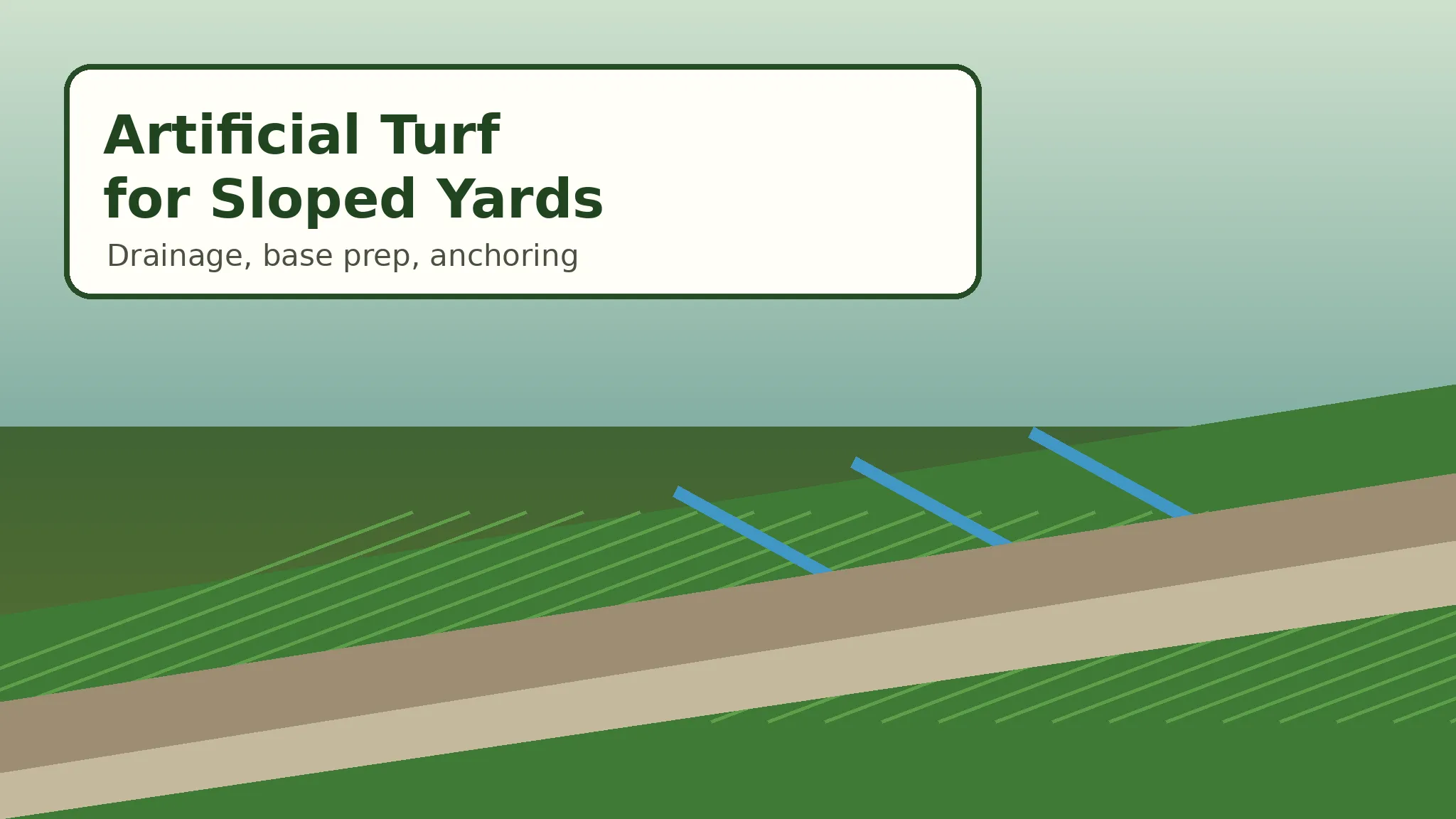
Artificial Turf for Sloped Yard Installation
Artificial Turf for Sloped Yard Installation: Drainage, Base Prep, and Secure Edges
Artificial turf for sloped yard projects can turn a hard-to-mow incline into a clean, usable landscape, but the installation cannot be treated like a flat lawn. Gravity changes how water moves, how aggregate settles, how seams carry stress, and how edges resist pull. A hillside turf system needs a stable base, a clear drainage path, deliberate panel layout, and anchoring that keeps the surface tight over time.
Planning a challenging residential turf project? Find a Go Green installation partner who can evaluate drainage, base preparation, and product fit before work begins.
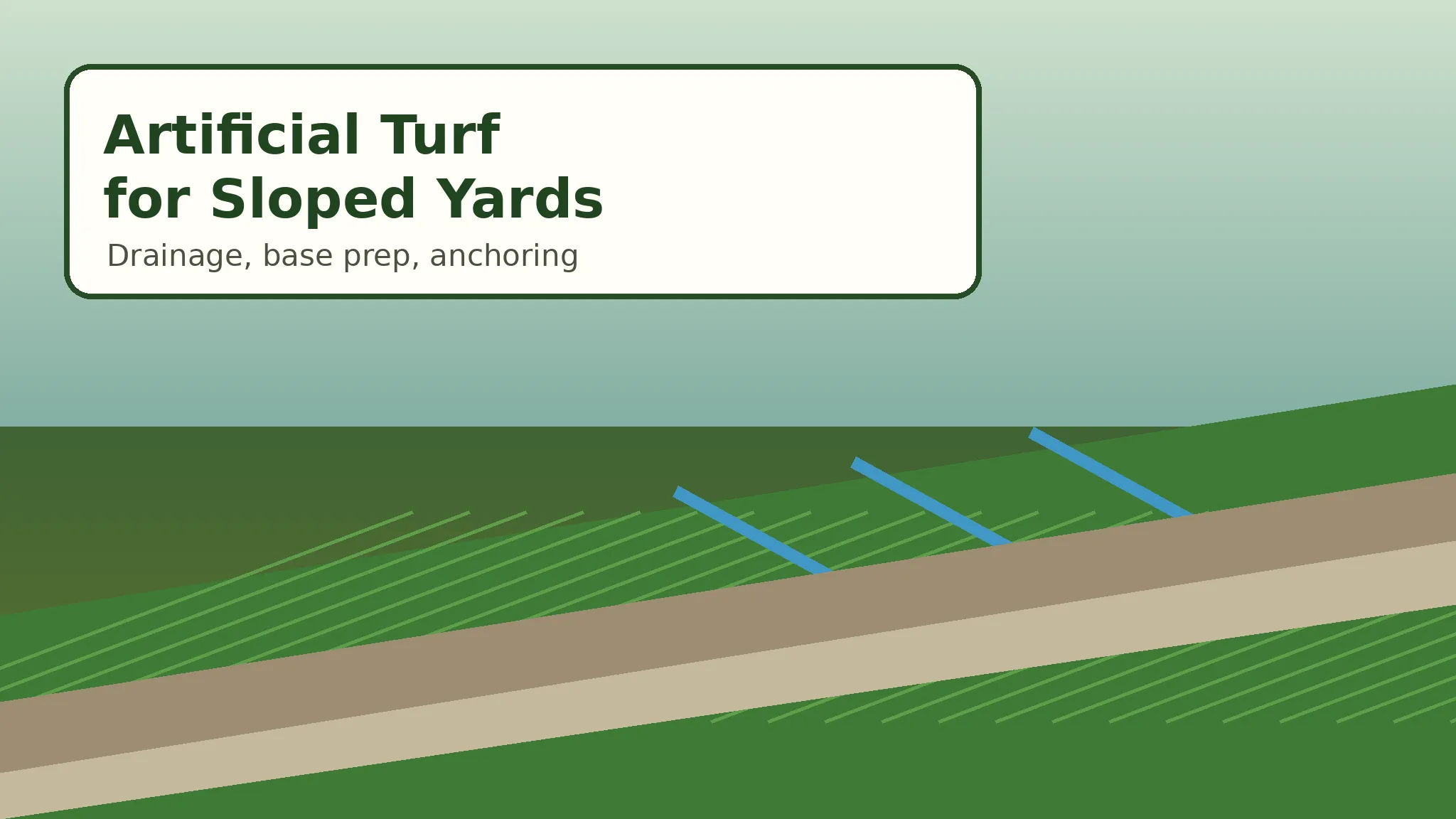
Why sloped yards need a different turf plan
On a level site, water has more time to filter through the turf backing and stone base. On a slope, runoff moves faster and concentrates at low points, borders, swales, and hardscape transitions. If the base is loose, thin, or poorly shaped, rainfall can carry fines downhill, create dips, or leave the turf unsupported along an edge.
Slopes also add installation tension. Turf rolls must lie flat without creeping downhill during layout. Seams need to stay calm instead of becoming stress lines. Nails, staples, edging, and any perimeter restraints must work together, not as last-minute fixes after the carpet is already positioned. This is why the best hillside installs are designed as systems, not simply as turf laid over dirt.
Go Green works with dealers and installers on application-specific turf choices. For sloped yards where rapid water passage is important, drainage-focused products may be part of the conversation, but backing performance still needs a properly built base beneath it. A fast-draining turf cannot correct poor grading or a blocked exit route for stormwater.
Start with slope, runoff, and drainage observation
Before excavation, walk the site after irrigation or review how it behaves during rain. Note where water enters from roofs, side yards, patios, and adjoining beds. Identify the downhill discharge point. Watch for erosion scars, silt deposits, standing water at the toe of the slope, or soil that stays soft after weather clears. Those clues show where the turf assembly will receive the most pressure.
Map the direction water should travel
The goal is not to trap water under artificial grass. The goal is to guide it through and away from the installed area without undercutting the base. Some projects need only careful contouring and a stable aggregate layer. Others may need drainage structures, edge transitions, or landscape revisions outside the turf footprint. The right answer depends on the slope length, soil absorption, rainfall exposure, and adjacent hardscape.
Match turf drainage to the site
Go Green’s AQUAMAXX 90 drainage turf is built for demanding drainage conditions and is listed with 600+ inches per hour of water permeability. That is useful context for installers evaluating wet residential areas, pool surroundings, or rainfall-prone slopes. Still, water that passes through turf must continue through the base and leave the area. For a layer-by-layer explanation, see Go Green’s guide to how artificial turf drainage works.
How should the base be prepared on an incline?
A hillside turf base needs to be stable, uniformly compacted, and shaped to support drainage. Installers typically remove unstable organic material and roots, then establish a subgrade that reflects the finished drainage plan. The aggregate base should not be dumped loosely and expected to hold. It should be placed and compacted in manageable lifts so the finished surface is firm from top to bottom.
Remove soft material before building back
Topsoil and decomposing organic matter are not reliable support layers. If they remain beneath the installation, they can shrink, absorb water unevenly, and cause low spots. Clearing the area also exposes irrigation issues, roots, burrows, and buried debris that should be resolved before turf is placed.
Use aggregate to create support, not a drainage shortcut
Base stone should help form a smooth, durable plane while letting water follow the planned route. The base material, depth, and compaction approach should be selected for site conditions, not copied blindly from a flat backyard checklist. A steep or runoff-heavy yard may need more restraint at borders and more attention to erosion protection than a mild grade.
Keep the final surface predictable
Small humps and dips become obvious after turf is secured. They can also alter where water slows or accelerates. Screeding and final shaping matter on slopes because installers have fewer chances to correct a visual or drainage issue once edges, seams, infill, and brushing are complete.
Installer takeaway: Build the base so it stays put under rain, foot traffic, and gravity. Turf should finish the surface, not hide an unstable foundation.
Drainage design prevents washout and toe-of-slope problems
Drainage on a slope is both a surface and subsurface issue. Surface runoff may skim across the pile during intense storms. Water that enters the turf must move through backing and base without saturating a weak area or carrying fines downhill. At the toe of the slope, water needs a receiving path rather than a dead end against a walkway, curb, or fence.
- At the top: reduce uncontrolled water entering the turf from roof downspouts, pavement, or bare soil where practical.
- Across the slope: preserve the drainage direction during grading, base installation, and seam planning.
- At the bottom: confirm where water exits and whether adjacent landscape or drainage features can accept it.
If drainage is already a project concern, Go Green’s companion article on artificial turf drainage systems explains why product backing, sub-base, and water escape routes should be evaluated together. That same systems thinking applies with extra urgency on hillsides.
Need a product and installation discussion for a complex site? Contact Go Green Synthetic Turf to connect with the team.
Anchoring artificial turf on a slope
Anchoring should resist shifting without creating visible puckers or restricting a clean finished edge. The top of the slope is especially important because the turf panel should not begin drifting downhill during placement or after seasonal movement. The lower perimeter matters too, since runoff and foot traffic often concentrate where the grade levels out.
Use perimeter restraint intentionally
Installers may use appropriate edging, nailer locations, or other site-specific restraints as the conditions require. The goal is a continuous boundary that supports secure fastening and preserves a crisp transition to planting beds, hardscape, or other landscape materials. Weak or interrupted edges are common starting points for lifting and erosion damage.
Increase fastening attention where force increases
A slope often warrants closer attention to fastener spacing at edges, curves, direction changes, and other tension points. The exact fastening method should follow the installer’s specifications, turf format, soil conditions, and project design. More hardware alone is not a substitute for compaction, edge planning, or a stable base.
Protect transitions
Where turf meets concrete, a wall, steps, or planting areas, the transition needs both visual accuracy and structural confidence. Avoid leaving water to carve a channel along a border. Avoid cuts that expose backing or invite separation. Clean transitions make the project look better and help the turf resist creep.
Plan seams to reduce stress and improve the finished look
Seam placement has a bigger impact on slopes than many property owners expect. A poorly located seam can sit in the path of concentrated runoff, cross a high-traffic line, or fall where panel tension is hardest to control. The best seam is the one the finished yard barely reveals and the drainage plan does not punish.
- Lay out rolls before cutting so pile direction, viewing angle, and grade direction make sense together.
- Avoid unnecessary small pieces that add seams on a challenging incline.
- Keep seams away from obvious water concentration paths when layout allows.
- Dry-fit carefully before adhesive, seam tape, or final fastening steps begin.
On hillside residential work, installers also need to think about access. If a wheelbarrow route, stair path, gate, or play route crosses the grade, layout choices should account for those loads. A beautiful seam plan on paper still needs to work with how the yard will be used.
Erosion control starts outside the turf roll
Artificial turf can remove the mowing and thinning issues that natural grass often faces on an incline, but erosion control is still a landscape question. Water entering from an unprotected bed above the turf can carry sediment onto the surface. A bare soil edge below the turf can wash back and undermine the perimeter. Installation quality improves when the surrounding landscape is included in the plan.
Stabilize soil at entries and exits
Review planting beds, mulch lines, swales, and drainage outlets near the turf. If those areas send mud onto the slope or cannot accept runoff from it, the new turf may appear to fail even when the turf material is performing as designed. A hillside project succeeds when surrounding water behavior is addressed.
Do not bury drainage mistakes with infill
Infill can support blade position and system performance depending on the selected turf, but it should not be treated as an erosion-control repair. If fines are migrating, edges are washing, or runoff is carving a line, correct the drainage and base issue rather than masking it at the surface.
Which Go Green turf considerations matter on a sloped yard?
Product choice should follow the site’s actual challenges. A residential slope with regular irrigation runoff may call for a different decision than a sunny grade near reflective glass, a pool-adjacent incline, or a pet area that needs frequent rinsing. Go Green’s product families help installers match the application rather than settling for one generic artificial grass specification.
- Drainage-focused yards: AQUAMAXX products are relevant where water movement is a priority and the base is designed to support that performance.
- Heat-exposed areas: installers should assess sun and nearby reflective windows before choosing turf, particularly on residential projects with complex exposures.
- High-use sections: traffic, access routes, and transitions should inform pile, resilience, and layout conversations.
The installation page explains why local soil, heat, drainage, seam placement, infill type, and securing methods all affect the finished project. Those variables become even more connected when the lawn is on a grade.
A practical sloped-yard installation checklist
- Study water movement. Identify inflow, runoff direction, low points, and discharge locations.
- Remove unstable surface material. Expose a reliable subgrade and correct hidden obstacles.
- Shape the grade deliberately. Preserve intended drainage instead of creating low pockets.
- Build and compact the base. Use a stable aggregate plan suited to the site.
- Choose turf for the application. Consider drainage needs, exposure, use, and installer guidance.
- Layout rolls before final cuts. Manage pile direction, seams, and waste with the slope in mind.
- Secure edges and transitions. Pay attention to the top, toe, curves, and hardscape borders.
- Finish and inspect. Check surface smoothness, edges, runoff behavior, and any areas prone to migration.
This process is useful for project owners asking better questions and for installers explaining why a hillside quote may involve more preparation than a flat, open lawn.
Common mistakes to avoid
- Ignoring runoff from outside the project area. Roof drains and hardscape can overwhelm an otherwise good turf plan.
- Using a flat-yard base mindset. Slopes need more attention to restraint, water paths, and compaction quality.
- Letting seams fall wherever rolls happen to meet. Layout should respond to slope, traffic, and visibility.
- Depending on turf drainage alone. The base and outlet must keep up with the turf backing.
- Waiting until the end to solve borders. Edge details should be part of the installation design from the beginning.
Artificial turf for sloped yard projects works best as a system
A slope does not rule out synthetic grass. It simply raises the standard for preparation. When drainage is planned, the base is compacted with care, seams are positioned intelligently, and edges are secure, artificial turf can create a cleaner residential landscape that is easier to use than a hard-to-maintain incline.
Ready to plan the next step? Contact Go Green Synthetic Turf or use the installer connection page to discuss your site’s drainage, product, and installation needs.
Leave a Reply